SAINT Treatment for Depression
The Stanford Accelerated Intelligent Neuromodulation Therapy model is showing great promise just three years after its initial launch.
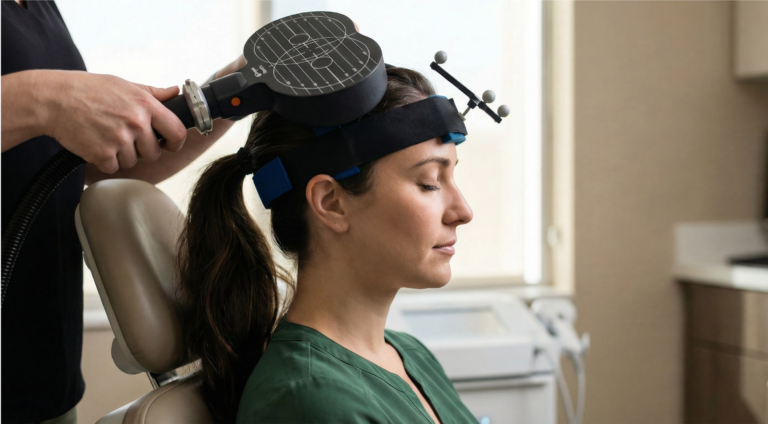
A Fast-Acting New Treatment for Depression
Stanford Accelerated Intelligent Neuromodulation Therapy (SAINT) is a newer, fast-acting transcranial magnetic stimulation (TMS) treatment for depression. This noninvasive, innovative therapy, developed at Stanford University, was FDA-approved and became commercially available to the general population in September 2022.
The true revelation of SAINT treatment is its accelerated time frame. SAINT is one type of neuromodulation therapy that has been shown to treat depression in as little as 5 days. This is particularly impressive when medication like selective serotonin reuptake inhibitors (SSRIs), on average, take about 4-6 weeks to work, and traditional TMS treatment is administered for 6 weeks.
While still early, treatment results have shown great promise, with the American Medical Association noting that standard TMS treatments improve symptoms in about 50–60% of patients, with over 30% achieving remission, while key trials conducted with SAINT found that 79% of patients achieved remission during the first month after treatment.
What is TMS Therapy?
TMS is a noninvasive brain stimulation approach to treat depression that targets the prefrontal cortex and generates a magnetic field that induces a strong, localized electric field in the brain. It is a safe and effective outpatient procedure that allows the patient to remain awake and alert without anesthesia or recovery time, enabling them to resume their normal daily activities after each session.
To start, a magnetic coil is placed on the scalp over the prefrontal cortex, where it delivers electrical energy to depolarize neurons in certain brain areas that play a major role in depression. Patients may experience a tapping sensation on the head and may have minor side effects, such as a headache or scalp discomfort, for a short period of time. It is FDA-approved for treatment-resistant depression, although there is a push from mental health professionals to use it as a first-line treatment for depression.
Traditional TMS takes approximately 6 weeks, with 5 treatment sessions per week. If patients are taking SSRIs or undergoing psychotherapy, they are generally allowed to continue these types of treatment while undergoing TMS, but this should always be discussed with the treatment team.
How Does SAINT Differ from Traditional TMS Therapy?
SAINT is a more truncated and precise form of TMS therapy, meaning the patient is still receiving TMS but in a shorter timeframe and with greater precision guided by brain imaging. It is also a more precise and personalized treatment approach compared to traditional TMS.
Before a patient undergoes SAINT, the treatment team takes images of the brain using functional magnetic resonance imaging (fMRI), which measures brain activity by detecting small changes in blood flow by tracking oxygen levels. The goal of the fMRI is to determine the precise location in each patient’s brain that is showing the most activity contributing to their depression. The coils are then placed strategically on the head, and the magnetic field is precisely focused on the brain areas mapped during the fMRI.
As previously mentioned, SAINT is a truncated version of traditional TMS. Instead of therapy 5 days a week for 6 weeks, patients undergoing SAINT will have 5 days of therapy over 1 week, shortening their treatment time by at least 1 month. SAINT takes place over 5 consecutive days, with 10 hours per day, and one treatment is administered every hour for a total of 10 treatments per day. Each treatment takes 10 minutes, and the patient may rest, read, work, or go for a walk between treatments.
Until recently, it was rare that treatment for depression could be administered in as little as 5 days, but this rapid-acting, high-dose, specifically tailored TMS treatment has shown good results.
The Consequences of Untreated Depression
Depression is a global disease that affects approximately 300 to 330 million people worldwide, about 4-5% of the population. In the United States, over 18% of adults (47.8 million) experienced depression in 2024 and 2025, and 29% of U.S. adults have been diagnosed with depression at some point in their lives, a record high.
When left untreated, depression can lead to an increase in chronic illnesses such as heart disease, weight gain, and chronic pain. It can also create severe strains on relationships and make it difficult to maintain school and work responsibilities, while also leading to an increased risk of dangerous behaviors such as self-harm and suicidal ideation.
Fortunately, depression can be treated with medications such as antidepressants, psychotherapy, and neuromodulation therapies, also known as brain stimulation. However, most people assume that antidepressants are the only way to treat depression, and this false presumption can increase treatment barriers, especially for people who are averse to pharmaceuticals.
What is Treatment-Resistant Depression (TRD)?
Treatment-resistant depression is a form of major depressive disorder that does not improve after administering two different types of antidepressants at full therapeutic dosage. Despite antidepressant treatment, patients often still have symptoms of persistent sadness, sleep issues, loss of pleasure, and feelings of guilt.
TMS is FDA-approved for treatment-resistant depression, meaning that to be covered by insurance, patients with depression must first fail two different antidepressant medications before physicians can prescribe TMS.
If a patient pays out of pocket and is unwilling to take antidepressants for any reason, they may still be able to receive TMS, such as SAINT, without needing a diagnosis of TRD. Physicians may also bypass this criterion if they feel their patients are not candidates for antidepressant therapy, but they would need approval from the insurance provider if patients chose to go through their insurance carrier.
Finding Help for Depression
For those struggling with depression, know that new treatments, like SAINT, are being developed to help alleviate the strain that depression can place on your mental health and well-being.
The most vital step is to reach out for help. Many successful treatments, including SAINT, are available now. Reach out to your primary care doctor or a mental health professional today to start your healing journey.
Last Updated: